

Pulses Market Forecast 2026–2036: Global Market to Reach USD 151.3 Billion by 2036 at 5.7% CAGR
Pulses Market
Pulses market growth driven by processing calibration, contract sourcing, protein standardization, and structured trade integration.
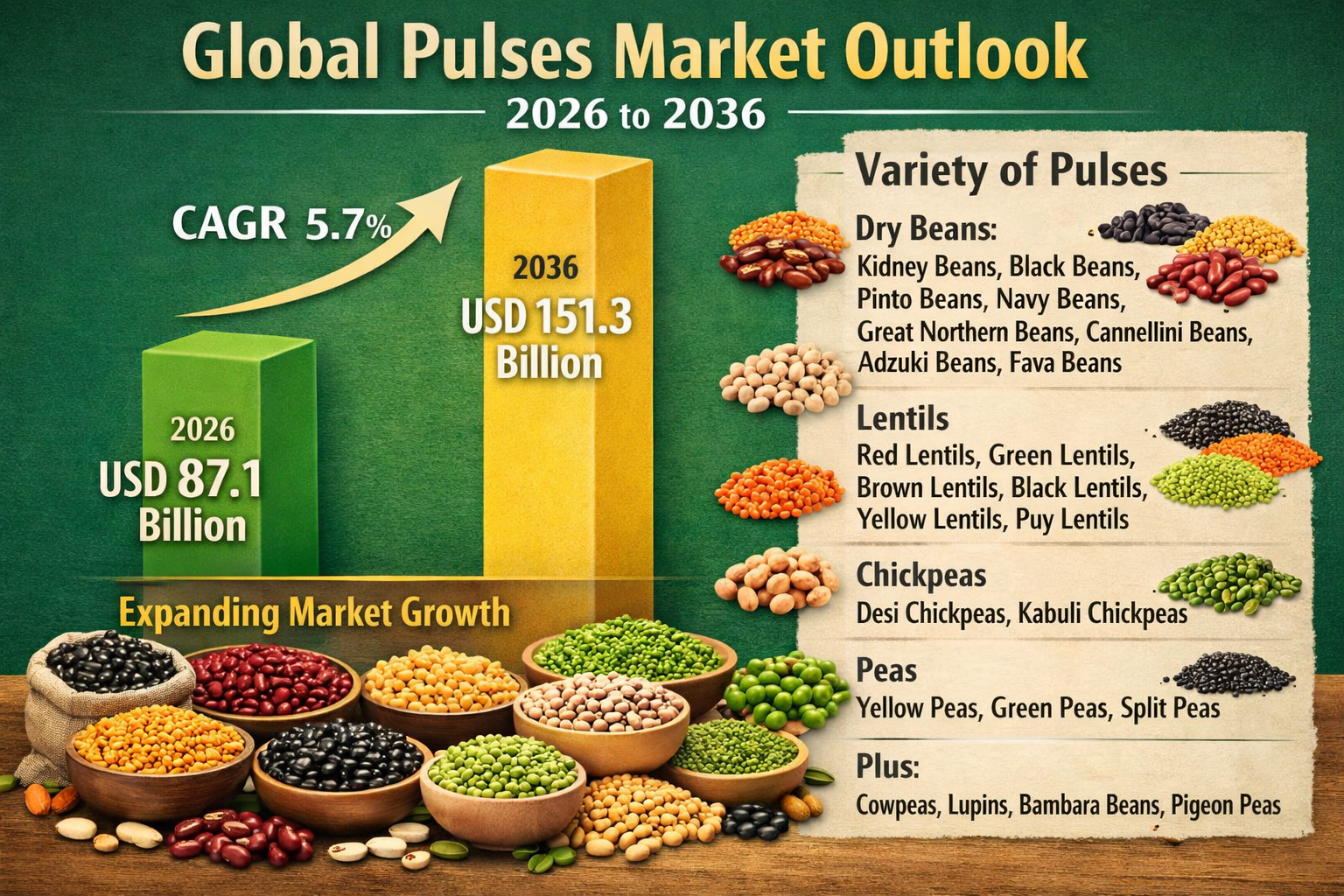
NEWARK, DE, UNITED STATES, February 20, 2026 /EINPresswire.com/ -- The global pulses market was valued at USD 87.1 billion in 2026 and is projected to reach USD 151.3 billion by 2036, expanding at a CAGR of 5.7% over the forecast period, according to analysis by Future Market Insights (FMI). Growth is being structurally driven by processing standardization, grading calibration, and contract-based procurement systems rather than short-term agricultural volatility.
Pulses are no longer positioned solely as bulk agricultural commodities. They are increasingly embedded as specification-driven inputs within structured food manufacturing pipelines. Cleaned, graded, split, and dehusked formats are gaining prominence as processors demand predictable moisture thresholds, particle-size uniformity, and defined protein concentration bands.
Request For Sample Report | Customize Report |purchase Full Report - https://www.futuremarketinsights.com/reports/sample/rep-gb-12667
Industrial Integration Anchors Long-Term Demand Stability
Unlike acreage-sensitive commodity cycles, pulses are becoming embedded in contract-based sourcing frameworks and documentation-led trade systems. This shift enhances long-term demand visibility across domestic consumption and export-oriented production corridors.
Key structural growth drivers include:
• Expansion of grading and moisture calibration standardization
• Integration into protein, starch, and fiber formulation systems
• Post-harvest automation improving yield consistency
• Compliance-ready documentation supporting cross-border trade
From 2026 to 2036, expansion is expected to be anchored in processing automation, protein band classification, flour conversion efficiency, and structured procurement agreements rather than speculative commodity flows.
Product Mix Reflects Dual Retail and Industrial Alignment
Dry Beans account for 38.7% of total market value in 2026, maintaining leadership due to compatibility across both household consumption and industrial applications. Lentils represent 22.3%, followed by Chickpeas at 18.6%, Peas at 14.2%, and Others at 6.2%.
Dry Beans benefit from established optical sorting, size grading, and moisture calibration systems that reduce batch variability. Their ability to convert efficiently into flour and protein concentrates reinforces their relevance across soups, ready meals, snacks, and bakery applications.
Across applications, Protein Source represents the dominant functionality at 30.0% of total demand. Pulses are increasingly processed into flour, isolates, and concentrates aligned with specification-driven manufacturing. Additional application shares include:
• Fiber Enrichment: 18.0%
• Starch Base: 14.0%
• Texturizer / Binder: 12.0%
• Emulsifier: 9.0%
• Clean Label Ingredient: 9.0%
• Gluten-Free Base: 8.0%
This multifunctional profile strengthens recurring procurement agreements and reduces substitution risk in industrial food systems.
Processing Infrastructure Emerges as Competitive Differentiator
Post-harvest capabilities are becoming central to value capture. Optical sorting, mechanical splitting, polishing, and calibrated drying systems improve throughput efficiency and minimize contamination risk. Moisture-controlled storage reduces post-harvest losses while supporting compliance with export documentation standards.
Suppliers delivering standardized protein bands, documented grading metrics, and traceability-backed shipments are securing structural advantages. As Murad Al-Katib, President and CEO of AGT Food and Ingredients Inc., noted in an interview with The Western Producer, sustainability-linked financing and documentation will increasingly shape capital allocation and procurement frameworks.
Regional Expansion Led by Infrastructure Depth
Global expansion is being shaped by cultivation structure, processing sophistication, and trade formalization rather than demographic growth alone.
Country-level CAGR projections (2026–2036) include:
• India: 6.3%
• China: 5.8%
• USA: 4.9%
• UK: 4.4%
• Germany: 4.1%
• Japan: 3.7%
India leads growth, supported by irrigation-backed cultivation, strengthening contract farming penetration, and expanding splitting and dehusking infrastructure. China’s 5.8% CAGR reflects increased packaged food integration and export corridor alignment. The United States benefits from automated grading systems and compliance-driven export frameworks.
European markets such as Germany and the UK demonstrate steady expansion anchored in harmonized documentation, moisture discipline, and industrial integration. Japan reflects moderate but structurally stable growth tied to calibrated import systems and consistent grading standards.
Competitive Landscape: Infrastructure-Led Scale Advantages
The market remains moderately fragmented, with the top fifteen companies accounting for 54.6% of total value in 2026. Competitive positioning is defined by integrated sourcing networks, post-harvest processing depth, and export compliance precision.
AGT Food & Ingredients leads with 6.9% market share, followed by ADM (6.1%) and Cargill (5.6%). Olam Agri (5.1%) and Louis Dreyfus (4.7%) reinforce scale advantages through coordinated cultivation sourcing and harmonized trade classification systems.
Mid-tier players including Bunge, Viterra, Richardson International, Scoular, SunOpta, Roquette, Ingredion, PURIS, Cosucra, and Vestkorn emphasize protein concentration, flour conversion, and compliance-ready packaging systems. Competitive intensity is increasingly centered on optical sorting capacity, moisture calibration discipline, and documentation transparency.
Recent strategic developments highlight this structural shift. In late 2024, AGT agreed to divest its MobilGrain shortline rail infrastructure in Saskatchewan to unlock capital while retaining logistics access. ADM announced a USD 26 million investment to expand automation and digital raw material handling capabilities at its Erlanger facility, reinforcing integrated processing depth.
Outlook Through 2036
Over the forecast period, pulses are expected to solidify their position as specification-driven agricultural inputs embedded within formalized trade and manufacturing systems. Contract-based sourcing, irrigation-backed cultivation, and compliance-ready export documentation will underpin long-term stability.
Operators capable of integrating cultivation reliability with calibrated post-harvest infrastructure and structured compliance systems are projected to capture a disproportionate share of incremental market value.
Why FMI: https://www.futuremarketinsights.com/why-fmi
Browse Related Insights
Pulses Market Share Analysis: https://www.futuremarketinsights.com/reports/pulses-market-share-analysis
UK Pulses Market: https://www.futuremarketinsights.com/reports/united-kingdom-pulses-market
USA Pulses Market: https://www.futuremarketinsights.com/reports/united-states-pulses-market
About Future Market Insights (FMI)
Future Market Insights, Inc. (FMI) is an ESOMAR-certified, ISO 9001:2015 market research and consulting organization, trusted by Fortune 500 clients and global enterprises. With operations in the U.S., UK, India, and Dubai, FMI provides data-backed insights and strategic intelligence across 30+ industries and 1200 markets worldwide.
Sudip Saha
Future Market Insights Inc.
+ +1 347-918-3531
email us here
Legal Disclaimer:
EIN Presswire provides this news content "as is" without warranty of any kind. We do not accept any responsibility or liability for the accuracy, content, images, videos, licenses, completeness, legality, or reliability of the information contained in this article. If you have any complaints or copyright issues related to this article, kindly contact the author above.
