

Acai Berry Market Forecast 2026–2036: Global Market to Reach USD 23,359.8 million by 2036 at 8.8% CAGR
Acai Berry Industry Size
The acai berry market is expanding steadily, driven by rising demand for antioxidant-rich superfoods, functional foods, and clean-label wellness products.
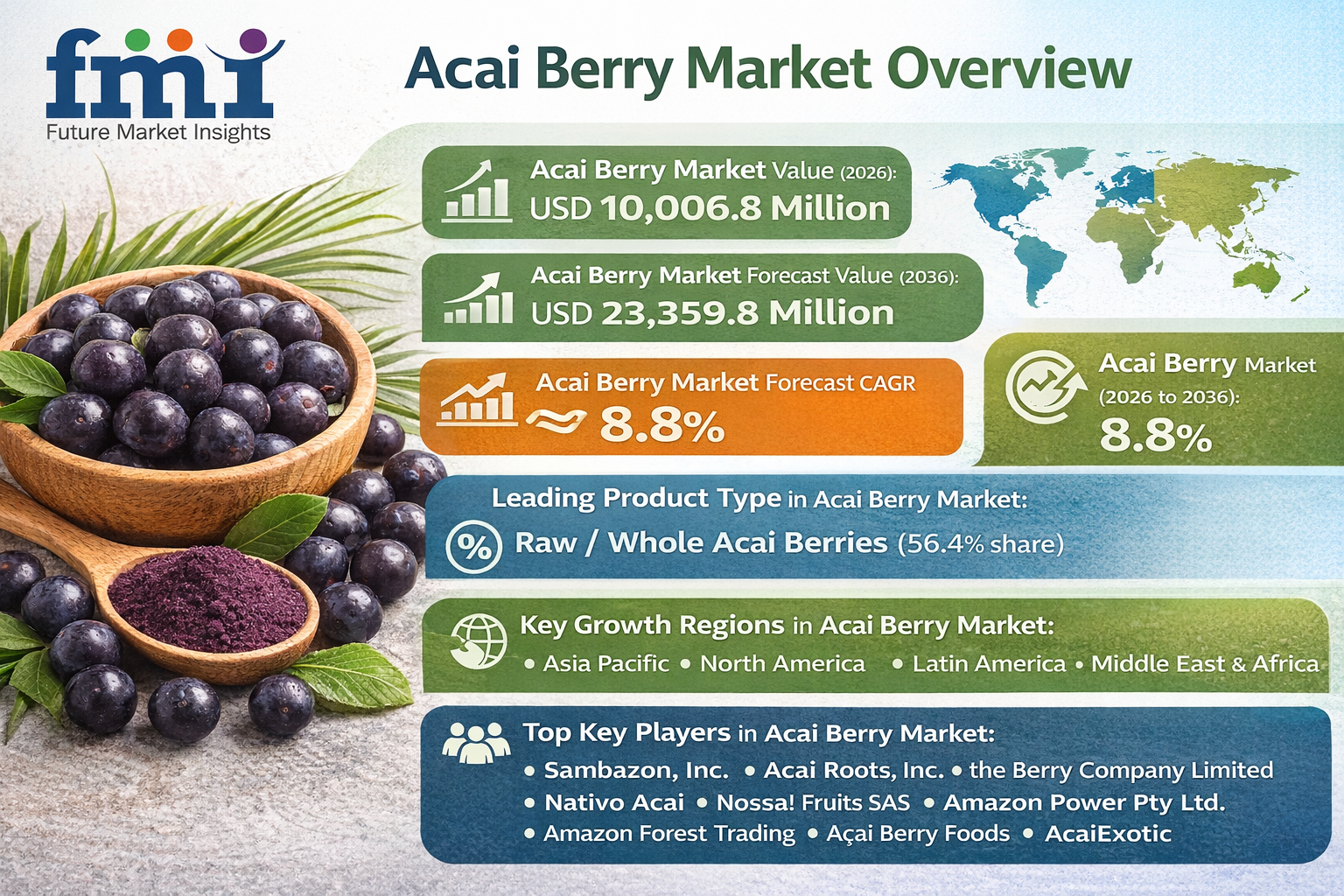
NEWARK, DE, UNITED STATES, February 19, 2026 /EINPresswire.com/ -- The global acai berry market is projected to grow steadily over the next decade, expanding from USD 10,006.8 million in 2026 to USD 23,359.8 million by 2036, registering a CAGR of 8.8%, according to the latest analysis by Future Market Insights (FMI). Growth is supported by sustained consumer demand for antioxidant-rich superfoods and the expanding integration of acai into functional foods, beverages, dietary supplements, and cosmetics.
Unlike fresh fruit-led categories, the acai berry market is structured around value-added formats such as frozen pulp, powders, purees, juices, and extracts. Market performance is closely linked to premiumization, clean-label positioning, and the ability to deliver consistent quality from a geographically concentrated Amazon supply base.
Traditional commodity fruit markets compete primarily on volume and price. In contrast, acai differentiates through documented antioxidant content, traceable sourcing, and controlled processing methods that preserve anthocyanins and nutrient density. Between 2026 and 2036, expansion will be driven more by nutraceutical-grade innovation, shelf-stable processing technologies, and wellness-driven consumption trends than by raw fruit trade alone.
To Explore Detailed Market Data, Segment-Wise Forecasts, and Competitive Insights, Request Sample Report! https://www.futuremarketinsights.com/reports/sample/rep-gb-1207
Acai Berry Market Snapshot (2026–2036)
Market size in 2026: USD 10,006.8 million
Market size in 2036: USD 23,359.8 million
CAGR (2026–2036): 8.8%
Leading product type: Raw / Whole Acai Berries (~56.4% share)
Dominant product claim: Conventional (~52.8% share)
Key growth regions: Asia Pacific, North America, Europe, Latin America, Middle East & Africa
Fastest-growing countries: India, Thailand, USA, UK, Mexico
Market Momentum
The acai berry market begins at approximately USD 10.0 billion in 2026 and maintains a strong upward trajectory throughout the forecast period. By 2031, accelerating demand across smoothie bowls, ready-to-drink beverages, nutraceutical capsules, and functional snacks pushes market value significantly higher as superfruit positioning expands in both retail and foodservice channels.
Between 2031 and 2036, growth intensifies as emerging markets increase wellness-oriented consumption, online nutrition platforms expand distribution reach, and manufacturers introduce shelf-stable and high-purity acai extracts. By 2036, the market reaches USD 23,359.8 million, sustaining its 8.8% CAGR over the decade.
Why the Market Is Growing
Acai demand is rising due to its association with antioxidant density, plant-based nutrition, and premium superfood branding. Food and beverage manufacturers incorporate acai into smoothie blends, dairy alternatives, snack bars, and cold-pressed juices to meet clean-label expectations.
Dietary supplement companies prioritize acai powders and encapsulated extracts for standardized antioxidant claims, while cosmetic formulators integrate acai oil and extracts into skincare products targeting natural positioning.
Material selection in this category is increasingly guided by nutrient preservation, traceability, and certification rather than volume alone. Supply chain discipline, cold-chain reliability, and processing proximity to Amazon harvesting regions remain critical for maintaining quality consistency and regulatory compliance.
Segment Spotlight
Product Type: Raw / Whole Acai Berries Lead with ~56.4% Share
Raw or whole acai berries dominate market structure because they serve as upstream inputs for multiple downstream formats. Processors retain flexibility to convert whole berries into frozen pulp, powders, purees, or extracts based on end-use requirements. This format enables better control over freezing, pulping, and drying processes while preserving anthocyanin levels under controlled conditions.
Other product forms—including frozen acai, powder, juice, and pulp and purees—support export stability, convenience, and nutraceutical applications.
Product Claim: Conventional Products Anchor Volumes (~52.8% Share)
Conventional acai products maintain leadership due to scalability, cost efficiency, and broader supply availability. Large-scale food and beverage manufacturers rely on conventional sourcing to maintain consistent volumes and competitive pricing.
Organic-certified products, while smaller in share, play a critical role in margin expansion and premium brand differentiation, particularly in developed markets emphasizing sustainability and traceability.
Regional Growth: Asia Pacific and North America Lead Expansion
Asia Pacific emerges as a high-growth region, with India and Thailand demonstrating rapid adoption of wellness beverages, smoothie formats, and nutraceutical products.
North America remains a mature but value-driven market, led by the United States, where acai is widely incorporated into smoothie bowls, frozen desserts, supplements, and clean-label functional foods.
Europe sustains steady growth supported by regulatory compliance standards, sustainability expectations, and integration of superfruits into established health-focused product portfolios.
Drivers, Opportunities, Trends, Challenges
Drivers: Rising demand for natural superfoods, expansion of functional food portfolios, growth of dietary supplements and wellness beverages.
Opportunities: Nutraceutical-grade extracts, high-pressure processing (HPP), cryogenic freezing technologies, certified organic and fair-trade sourcing.
Trends: Clean-label positioning, antioxidant standardization, plant-based product innovation, premium smoothie and bowl formats in retail and foodservice.
Challenges: Supply concentration in the Amazon region, seasonal yield variability, cold-chain dependency, certification costs, and quality standardization requirements.
Country Growth Outlook (CAGR 2026–2036)
India – 13.0%
Thailand – 12.0%
USA – 8.2%
UK – 6.8%
Mexico – 6.3%
India represents the fastest-growing market, driven by online nutrition platforms, gym-linked consumption, and rapid expansion of nutraceutical brands. Thailand benefits from wellness tourism and hospitality-led beverage innovation. The United States emphasizes premium-grade sourcing and ingredient differentiation, while the UK and Mexico demonstrate stable growth through beverage and supplement integration.
Competitive Landscape
The acai berry market features a quality-driven competitive environment where differentiation centers on sourcing transparency, processing integrity, certification support, and documented antioxidant metrics.
Leading participants include Sambazon, Inc., Acai Roots, Inc., The Berry Company Limited, Nativo Acai, Nossa! Fruits SAS, Amazon Power Pty Ltd., Amazon Forest Trading, Açaí Berry Foods, and AcaiExotic.
These companies compete through organic certification, Fair Trade alignment, cold-pressed processing methods, freeze-drying technologies, and documented antioxidant assays. Competitive advantage is built on verified quality parameters, supply reliability, and the ability to support food, beverage, supplement, and cosmetic manufacturers with consistent, traceable acai ingredients.
Explore More Related Studies Published by FMI Research:
Acai Berry Extracts Market: https://www.futuremarketinsights.com/reports/acai-berry-extracts-market
Mulberry Market: https://www.futuremarketinsights.com/reports/mulberry-market
Boysenberry Market: https://www.futuremarketinsights.com/reports/boysenberry-market
Sudip Saha
Future Market Insights Inc.
+18455795705 ext.
email us here
Legal Disclaimer:
EIN Presswire provides this news content "as is" without warranty of any kind. We do not accept any responsibility or liability for the accuracy, content, images, videos, licenses, completeness, legality, or reliability of the information contained in this article. If you have any complaints or copyright issues related to this article, kindly contact the author above.
